
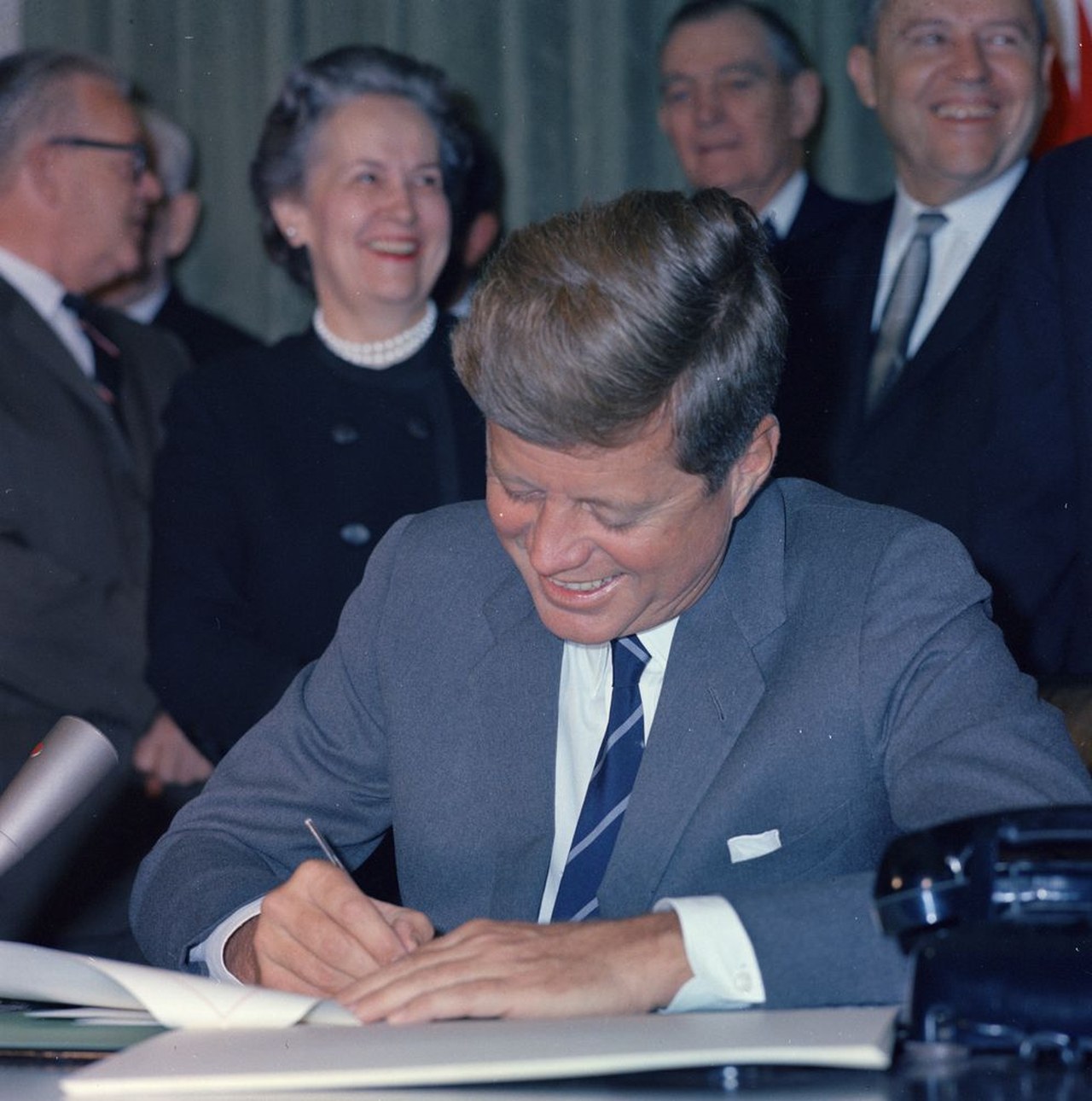
President John F. Kennedy signed Public Law 88-164 on Oct. 31, 1963, putting federal construction money behind research centers, university clinics and community facilities for people with what was then called mental retardation. The statute itself, on GovInfo, lays out the money year by year; Kennedy's signing remarks and the 1962 panel report that led to the law are archived by the American Presidency Project and the National Archives.
Today the term is intellectual disability. This story uses the old wording only in names, titles and quotes.
Part 1 of this series began with a school meant to teach and send people home, and Part 2 showed how eugenics recast institutions as places to hold people for life. By the early 1960s, a presidential panel counted more than 200,000 children and adults living in residential institutions, mostly at public expense. This part follows the five years when the federal government took up the issue in earnest, and the hidden-camera book that showed the public what federal money had not yet reached.
A panel, appointed in 1961
Kennedy called for a national plan on Oct. 11, 1961, and appointed the President's Panel on Mental Retardation on Oct. 17. The panel had 27 members, most of them physicians or Ph.D.s, and was chaired by Leonard W. Mayo. Eunice Kennedy Shriver, the president's sister, served as a consultant; the report lists her as Mrs. R. Sargent Shriver Jr.
The panel delivered A Proposed Program for National Action to Combat Mental Retardation on Oct. 16, 1962. It covered research, prevention, clinical and social services, education and employment, residential care, the law, and how services should be organized and coordinated. Its opening estimates set the scale:
- About 5.4 million people, an estimated 3 percent of the population, had an intellectual disability by the definitions of the day.
- More than 200,000 lived in residential institutions.
- States and localities spent $300 million a year building and running those institutions.
The report also broke with the thinking behind the eugenics era. Citing World War II draft records, it noted that rejections for "mental deficiency" varied widely by state, region and race, and it said modern science pointed to a lack of opportunity, not heredity, as the reason. The report's language is of its time, but on that point it rejected the hereditary thinking that had helped fill the institutions.
From a message to a law
On Feb. 5, 1963, Kennedy sent Congress a special message on mental illness and mental retardation. He described state hospitals and homes that were understaffed and overcrowded, and said average spending in institutions for both groups was about $4 a day per patient, and under $2 in some states. He promised a new approach in which "reliance on the cold mercy of custodial isolation will be supplanted by the open warmth of community concern and capability."
Congress passed two bills that year. The week before the main signing, Kennedy approved the Maternal and Child Health and Mental Retardation Planning Amendments, which he described as aimed at a major cause, the lack of care before birth and in infancy. Then came S. 1576, the Mental Retardation Facilities and Community Mental Health Centers Construction Act of 1963. Its main parts, as written in the statute:
| Part of the law | What it paid to build | Amounts authorized |
|---|---|---|
| Title I, Part A | Research centers on mental retardation and human development | $6 million (fiscal 1964), $8 million (1965), $6 million a year (1966-67) |
| Title I, Part B | Clinical facilities associated with a college or university | $5 million (1964), $7.5 million (1965), $10 million a year (1966-67) |
| Title I, Part C | Public and nonprofit facilities, through grants allotted to states | $10 million (1965) rising to $30 million (1968) |
| Title II | Community mental health centers | $35 million (1965), $50 million (1966), $65 million (1967) |
| Title III | Training of teachers of children with disabilities | $11.5 million (1964), $14.5 million (1965), $19.5 million (1966) |
Most of the law was about buildings. Titles I and II paid for construction, not for the staff who would work inside. At the signing in the White House Cabinet Room, Kennedy said doctors could not identify the cause in 75 percent of cases, and that the country needed about 200,000 teachers for children with disabilities but had about 60,000. He also announced a new Division of Handicapped Children and Youth in the U.S. Office of Education, led by Samuel Kirk of the University of Illinois. Kennedy was assassinated 22 days later.
Where the 1963 law led
The 1963 act is the root of today's developmental disabilities law. According to the federal Administration for Community Living (ACL), Congress amended it in 1970 with a law that introduced the term developmental disability and extended coverage to people with cerebral palsy, epilepsy and certain other neurological conditions that begin before age 18. ACL also traces today's University Centers for Excellence in Developmental Disabilities to the university affiliated facilities established in 1963; Part B of the law is the section that paid to build university-associated clinical facilities.
On May 11, 1966, President Lyndon B. Johnson signed Executive Order 11280, creating the President's Committee on Mental Retardation. It was chaired by the secretary of health, education and welfare, with up to 21 members from public or private life, and the order named the two 1963 laws as the legal foundation for the federal effort.
'Christmas in Purgatory'
New laws did not change life on the wards overnight. In the early fall of 1965, Sen. Robert F. Kennedy of New York toured several of his state's institutions, and his public reaction angered officials who said he had seen only the worst. Burton Blatt, then working on a research project at The Seaside, a Connecticut regional center, decided to look for himself.
In December 1965, Blatt and his friend Fred Kaplan, a freelance photographer, visited five state institutions in four eastern states at their own expense. Staff members, including two superintendents who risked their jobs, took them to the parts of each institution they were most ashamed of. Kaplan carried a hidden camera on his belt and took hundreds of photographs without ward staff noticing. "There is a hell on earth, and in America there is a special inferno," Blatt wrote in the book's introduction.
The first section of the book covered four institutions in three states. The authors described dormitories so crowded that beds were pushed side by side and head to head, locked doors everywhere, and seclusion cells about seven feet square in every institution they visited, one holding a boy who had been there for several days over a minor rule violation. They saw children with their hands and legs tied, adults sitting on benches in day rooms with nothing to do, and infants lying in cribs with no toys and no adult contact.
They blamed staffing as much as anything. One attendant, with a single assistant, was responsible for more than 100 adults and asked the visitors for two more seclusion cells. The authors concluded that the shortage of staff was a major reason for the heavy use of seclusion and restraint. They also wrote that staff had to believe the people in their care were human beings who could learn.
The second section showed the contrast. The four institutions spent less than $7 a day per resident, one less than $5. The Seaside spent $12. It had about 250 residents and more than 100 staff, small enough for every worker to know every child. Blatt argued then that the worst conditions came from budgets, buildings, untrained staff and poor planning, not from institutions as such. He later went further: a foreword to a 1974 edition notes that in Souls in Extremis he called for closing institutions and building no more.
The authors masked people's eyes in the photos and never named the institutions. According to the Pennhurst Memorial & Preservation Alliance, they printed 1,000 copies in 1966 and sent them free to legislators, university professors and early advocacy groups, and the response led Allyn and Bacon to publish a wider edition. The book called for a national examination of every institution, at least doubling per-resident spending, shrinking institution populations, and a board of outside visitors in each state, appointed by the governor and reporting to top state officials.
Why this matters for providers and DSPs
- Staffing drives restraint. Blatt and Kaplan tied seclusion and restraint directly to one worker covering 100 people. When a house runs short, the risk of harsh shortcuts rises. Adequate staffing and positive behavior support are the modern answer to that attendant's question.
- Belief comes first. The authors said staff had to believe residents could learn. That belief is the core of habilitation and of the skill-building DSPs do every day.
- Small and known works better. The Seaside's advantage was that every worker knew every child. Consistent staffing and real relationships still matter more than the size of the budget line.
- Buildings are not services. The 1963 law paid for construction, not the people inside. Today, paying and keeping the workforce is still one of the hardest parts of community services.
- Outside eyes help. Blatt wanted independent visitors with direct access to state leaders. Today that role belongs to licensing reviewers, human rights committees and protection and advocacy agencies; cooperate with them.
- Report through the right channels. Blatt and Kaplan exposed abuse but still masked faces and withheld names. If you see harm, report it under your agency's policy and state law, and never photograph or post images of people you support without consent. For how the institutions eventually emptied, see our explainer on moving from institutions to community.