
Pennsylvania's Pennhurst State School and Hospital held more than 10,500 people over eight decades before it closed in 1987, according to historian Dennis Downey's essay in the Encyclopedia of Greater Philadelphia. The fullest record of daily life there comes from a federal judge's 1977 findings in Halderman v. Pennhurst, and the best record of what happened next comes from a five-year federal study of the people who moved out, published by the U.S. Department of Health and Human Services in 1985.
Today the term is intellectual disability. This story uses older wording only in names, titles and findings quoted from the record.
Part 2 of this series traced how eugenics turned institutions into places to hold people for life. Pennhurst was built in that era. This part follows the people who lived there: what the court saw on the wards, who finally left, and how they fared in small homes in their own communities.
Built to keep people apart
Pennhurst opened in 1908 in rural Chester County near Spring City, about 30 miles from Philadelphia. Downey writes that Philadelphia public health officials, worried about what they saw as a rising tide of inherited "feeble-mindedness," persuaded the state legislature to fund what amounted to permanent quarantine on a 1,400-acre campus. According to the Pennhurst Memorial & Preservation Alliance, a state commission in 1913 recommended custodial care so that residents would not have children.
The place was crowded from the start. The alliance's timeline cites a 1930 trustees' report that counted 1,247 residents, 192 employees and about 900 applications for admission waiting on file. Residents worked the fields, the dairy farm and the woodshop, and Downey notes that critics compared the arrangement to peonage, or forced unpaid labor. The federal court later put the population high at nearly 4,000 in the early 1960s.
'Suffer the Little Children'
In 1968, Philadelphia newsman Bill Baldini aired a five-part television report called "Suffer the Little Children." Downey describes footage of half-clothed children wandering the wards with little more than Baldini's spare narration over the sights and sounds of the place. The alliance points out it was not the first exposé: newspaper stories and legislative inquiries had targeted Pennhurst since shortly after it opened, and little changed. Two years earlier, the photo essay covered in Part 6 had shown similar back wards in other states.
What the court found in 1977
In 1974, the family of a resident filed a class action, and the federal government and the Pennsylvania Association for Retarded Citizens later joined it. After a trial in 1977, U.S. District Judge Raymond J. Broderick issued his findings on Dec. 23, 1977. At that point Pennhurst had about 1,230 residents and about 1,500 staff.
The judge wrote that the staff, on the whole, seemed dedicated and were trying hard to cope. The problems, he found, came largely from overcrowding and understaffing. When professionals left, their jobs were often not refilled and their work fell to direct care staff; 19 professionals had left in two years without being replaced. Among his other findings:
- Restraints were used to control people in place of adequate staffing.
- Seclusion rooms had been used as punishment. One 18-year-old spent six straight days in seclusion in 1974.
- Day rooms were often so loud that many residents simply stopped talking.
- Almost every service had a long waiting list. As of April 15, 1977, 511 residents were waiting for occupational therapy.
- Many residents had lost skills they had when they arrived.
The named plaintiff, Terri Lee Halderman, was admitted in 1966 at age 12. In her 11 years there, the court found, attacks and accidents cost her several teeth and left her with a fractured jaw, broken fingers and a broken toe. Before she came to Pennhurst she could say a handful of words, including "mamma" and "dadda." By the trial she no longer spoke. "Pennhurst provides confinement and isolation, the antithesis of habilitation," Broderick wrote, using the word for the teaching and support people need to build skills, now usually called habilitation services.
On March 17, 1978, he ordered the state and five southeastern Pennsylvania counties to provide suitable community living arrangements for Pennhurst's residents. The legal fight that followed, including two trips to the U.S. Supreme Court, is the subject of a later part of this series. Downey notes the case settled in 1984, and Pennhurst closed three years later.
Who left, and where they went
The study, led by James W. Conroy of Temple University and Valerie J. Bradley of the Human Services Research Institute, followed the 1,154 people who lived at Pennhurst on the day of the 1978 order. Their average age was 39, and they had lived at Pennhurst for an average of 24 years. In the language of the time, 86 percent were labeled severely or profoundly retarded. Just over half did not use speech, and a third had a history of seizures.
They moved to what Pennsylvania called community living arrangements, the forerunner of today's group home. Most served three people in an ordinary house, were staffed whenever residents were home and were run by private providers under contract with county programs. On weekdays, everyone left the house for a day program.
What the study found
The authors' bottom line was that the average person who left Pennhurst was better off. People still at Pennhurst kept developing too, but far more slowly. Key results from the 1985 report:
| Measure | At Pennhurst | After moving |
|---|---|---|
| Adaptive behavior (everyday self-care and independence) | No significant improvement among matched people who stayed | About 10 times the growth of the matched people still at Pennhurst |
| Hours of service per month | 189 (156 where they lived, 33 in day programs) | 225 (104 at home, 121 in day programs) |
| Families strongly favoring community placement | Under 20% before the move | Over 60% after the move |
| Interviewed residents who consistently said they were happy where they lived | 12 of 30, in 1980 | 22 of the same 30, after moving |
People with the most severe disabilities were among those who gained the most. The number of daily prescription drugs per person went down after the move. The neighbor surveys were striking too: six months after the homes opened, only about 28 percent of neighbors knew one had moved in. Neighbors' attitudes dipped slightly at first and were back where they started by 20 months.
Families' biggest remaining worry was permanence. Only 15 percent agreed that funding for the new homes was secure and permanent, and many saw the institution, for all its problems, as a guarantee of lifelong care.
Where the savings came from
Community homes cost less on average, and the study traced nearly all of the difference to pay. Pennhurst's workers were state civil service employees, almost all unionized. They earned about 30 percent more on average than community staff at private agencies, and their benefits equaled 63 percent of salary, twice the community rate. An hour of direct care staff time in the community homes cost about 40 percent of what it cost at Pennhurst.
After closure
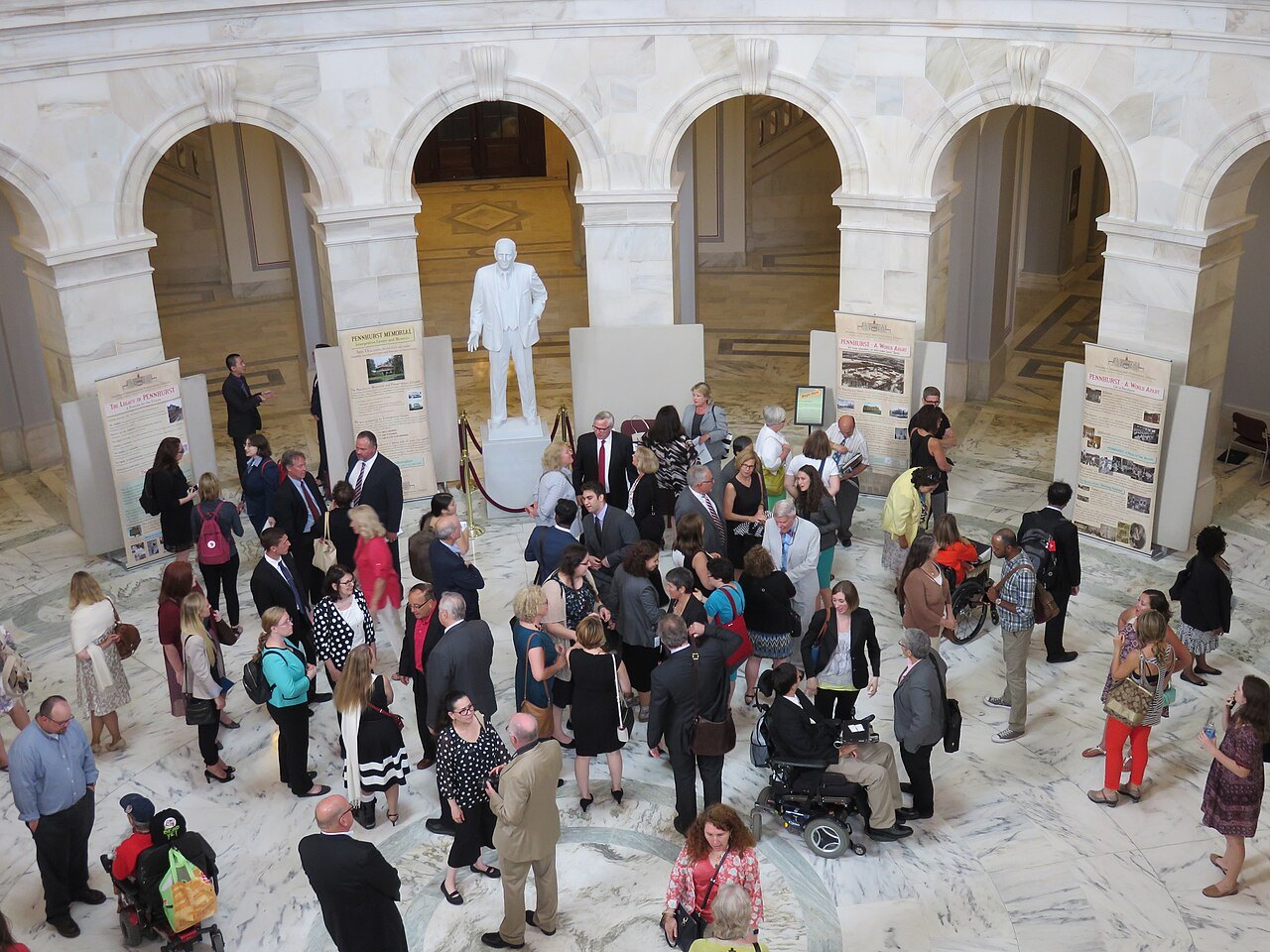
The empty campus fell into disrepair after 1987. In 2010, the state, the alliance and the Public Interest Law Center of Philadelphia dedicated a historical marker at the site. That same year a for-profit Halloween attraction opened on part of the old grounds, which the alliance protested. Through the alliance, Pennhurst joined the International Coalition of Sites of Conscience, a network of places that remember struggles for justice. In 2016 the alliance's traveling exhibit was shown in a U.S. Senate office building in Washington, as in the photo above.
Why this matters for providers and DSPs
- Short staffing turns into restraint. The court tied restraint at Pennhurst directly to too few staff. When a house runs short, the same pressure returns. Staffing levels are a rights issue, not just a budget line.
- Skills need daily practice. The judge found people lost skills, like using the toilet, because they had no chance to practice them. The big gains came when people did everyday tasks themselves at home. That is the heart of the work DSPs do.
- Small, ordinary homes worked, even for people with the most support needs. Most of the people who moved had severe disabilities, and they still made the largest gains.
- Families' fears can change, but their worry about stability is fair. Most Pennhurst families opposed the move and later strongly supported it. What they still feared was that the home would not last. Steady staffing and dependable provider agencies answer that worry.
- The savings came out of community paychecks. Forty years ago, the study found community care cost less mostly because private agency staff earned less. That wage gap is still at the center of today's DSP pay debates.
- Remember the people, not the ghost story. Some older adults you support may have lived in an institution like this one. Treat that history with respect. For how the institutions emptied nationally, see our explainer on moving from institutions to community.