
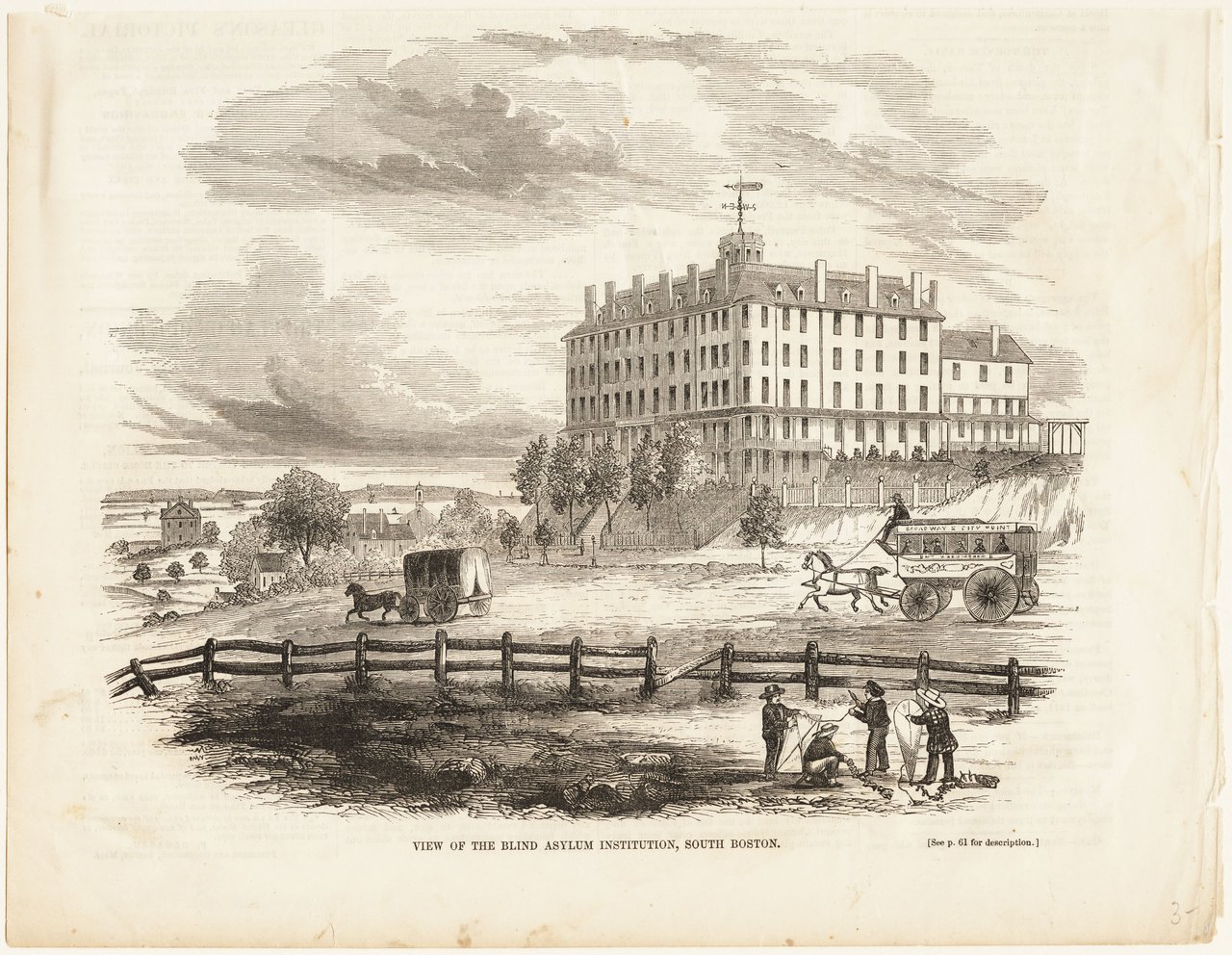
Massachusetts lawmakers agreed in May 1848 to spend $2,500 a year, for three years, on a test: could a teacher help 10 children with intellectual disabilities learn? The request came from Samuel Gridley Howe's Feb. 26, 1848, report to the legislature, and a note printed with it that October records that a school had opened in South Boston with several pupils already under instruction.
This is Part 1 of The Long Road Home, a history of how services for people with intellectual disabilities got where they are. It starts with a school that promised to teach children and send them home, and follows how that promise changed.
A survey of 100 towns
In 1846 the legislature authorized a three-member commission, chaired by Howe, to count the people the law then called idiots and to report whether anything could be done for them. Howe already ran the Perkins Institution for blind students in South Boston.
His 1848 report said the commission had examined 574 people in nearly 100 towns, from the coast to the western border. Of those, 220 were supported as town or state paupers, mostly in almshouses, where Howe wrote they were left without special care or instruction. Children kept at home were sometimes subjected to harmful folk remedies by parents who had no guidance.
The report also carried ideas that later did great harm. Howe treated disability as a sign that parents had broken natural laws, and he hoped to reduce the number of disabled people in future generations. Part 2 of this series follows how those beliefs hardened into the eugenics movement.
What the experiment tried
Howe pointed to schools already running in Europe, especially the work of Édouard Séguin in Paris, as proof that teaching could work. He argued the state should open a school "if it were but a matter of experiment."
Lawmakers agreed. The 1848 resolve created an experimental school at Perkins for 10 pupils. James B. Richards was the teacher. A Quaker journal that reviewed the school's first annual report in 1849 described the methods: exercise and physical care, training of the senses, and teaching whole words, like hat, before single letters. It described a 6-year-old boy who could not stand or feed himself when he arrived and, after a year, could walk with a little help, feed himself and speak in simple sentences.
The language of these documents is harsh. Words like idiot and feeble-minded were the official terms of the time, and this series uses them only when quoting or naming institutions and laws.
From experiment to institution
The experiment became permanent quickly:
| Year | What changed | Source |
|---|---|---|
| 1850 | Incorporated as the Massachusetts School for Idiotic and Feeble-Minded Youth | Massachusetts Archives |
| 1851 | Legislature grants $5,000 a year for 30 state-funded pupils after finding the experiment successful | 1863 trustees' report |
| 1857 | $7,500 a year for 45 state pupils | 1863 trustees' report |
| 1861 | $9,000 a year for 55 state pupils | 1863 trustees' report |
| 1863 | 76 pupils enrolled: 68 state, 2 from Rhode Island, 6 private | 1863 trustees' report |
The trustees' 1863 report, signed by Howe, described a school still built around teaching. Some former pupils, it said, had gone home and were earning a living with support from family or friends. It noted similar schools in Connecticut, New York, Pennsylvania, Ohio and Kentucky, and said demand from parents kept growing faster than funding.
Howe's warning
In 1866 Howe spoke at the laying of the cornerstone of New York's new state institution for the blind at Batavia. Instead of praising large institutions, he warned against them. People with disabilities, he told the audience, should be kept among the general community, not gathered together:
"Separation, and not congregation, should be the law of their treatment."
He urged keeping children close to family, friends and neighbors during the years when those ties form. The speech was about blind students, but the argument applied to every institution he had helped build.
The drift toward custody
After Howe's death in 1876, the school he founded moved in the direction he had warned against. According to the Massachusetts Archives:
- 1883: renamed the Massachusetts School for the Feeble-Minded, with a separate asylum department for people past school age or not helped by instruction
- 1887 to 1924: led by superintendent Walter E. Fernald
- 1890 to 1892: moved to a new campus in Waltham; the South Boston site closed
- 1925: renamed the Walter E. Fernald State School
- 1993: renamed the Walter E. Fernald Developmental Center
- November 2014: closed permanently, after a closure plan announced in 2003 was fought for a decade
A school created to teach children and return them home ended up, for many residents, as a place to live for life. Part 5 of this series covers what happened to some of those residents at Fernald after World War II. For how the institutional era ended nationally, see From institutions to community.
Why this matters for providers and DSPs
- Teaching was the original goal. Howe's pupils were there to learn skills and go home. That is close to what habilitation services aim for today: building skills a person chooses and uses in their own life.
- Funding shapes design. Each expansion came with conditions tied to how many state pupils the school had to take. Then as now, how services are paid for shapes who gets served and where.
- Programs drift. A small school with a clear purpose grew into a large institution with a custodial wing. Agencies can check for the same drift today: whether day programs, homes and plans still aim at the person's goals or have settled into routine.
- Language carries assumptions. The labels in these records came with beliefs about worth and potential. The shift to person-first and disability-led language is part of the same history; see the medical and social models of disability.
- Community ties matter. Howe's warning about separating people from family and neighbors is the same idea behind today's community-based services. DSPs who help people keep and build relationships outside their program carry that forward.